First day cover ·
Inheritance Planning: Why Families Need More Than a Dollar Figure
Families often have different expectations about inheritance. Regular, thoughtful conversations can clarify plans, costs and the reasons behind them.

Inheritance plans can be clear in a parent’s mind and still come as a surprise to their children. A survey of 2,500 adults ages 25 to 60 with at least one living parent, and 2,500 people age 55 or older with at least one adult child, found gaps in what the two generations expect. The findings point to a practical lesson: families can reduce confusion by discussing plans over time, including what may be passed on and what responsibilities could come with it.
Parents and children picture different estates
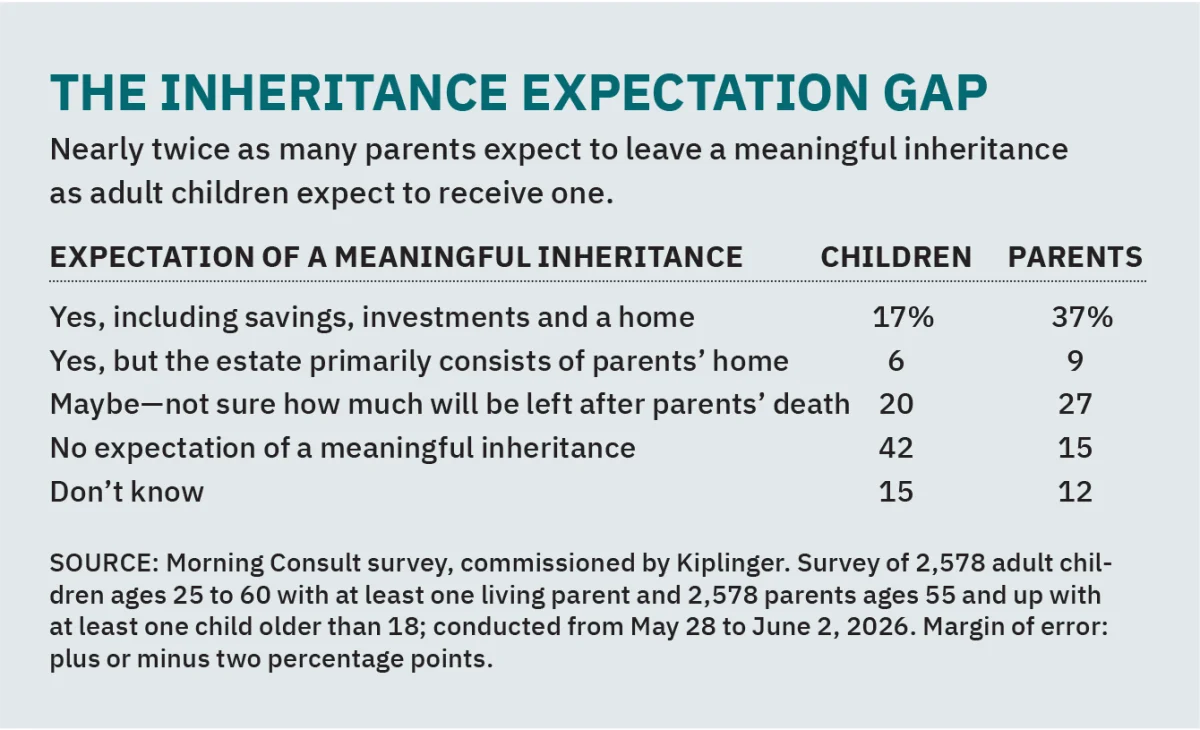
Nearly half of the parents surveyed said they plan to leave a meaningful inheritance. Just 24% of the adult children said they expect to receive one. The generations also differed on what assets parents may leave. Half of parents said their estate includes traditional or Roth IRAs and 401(k)s, compared with about one-third of children who thought those accounts were included. Real estate showed a similar gap: 54% of parents said it was part of their estate, while 32% of children thought it was.
Those differences matter because an inheritance can bring decisions and costs along with money. For example, non-spouse beneficiaries of an IRA generally must withdraw the account by the end of the 10th year after the owner’s death. A family member who doesn’t know about that timeline may have little time to understand the account and plan for withdrawals.
A home can also involve ongoing expenses, such as property taxes, homeowners association fees and utilities. If several siblings inherit a property together, they may need to agree on whether to keep, sell or maintain it. Talking through these possibilities beforehand can help family members understand the choices ahead.
Silence isn’t limited to wealthy families
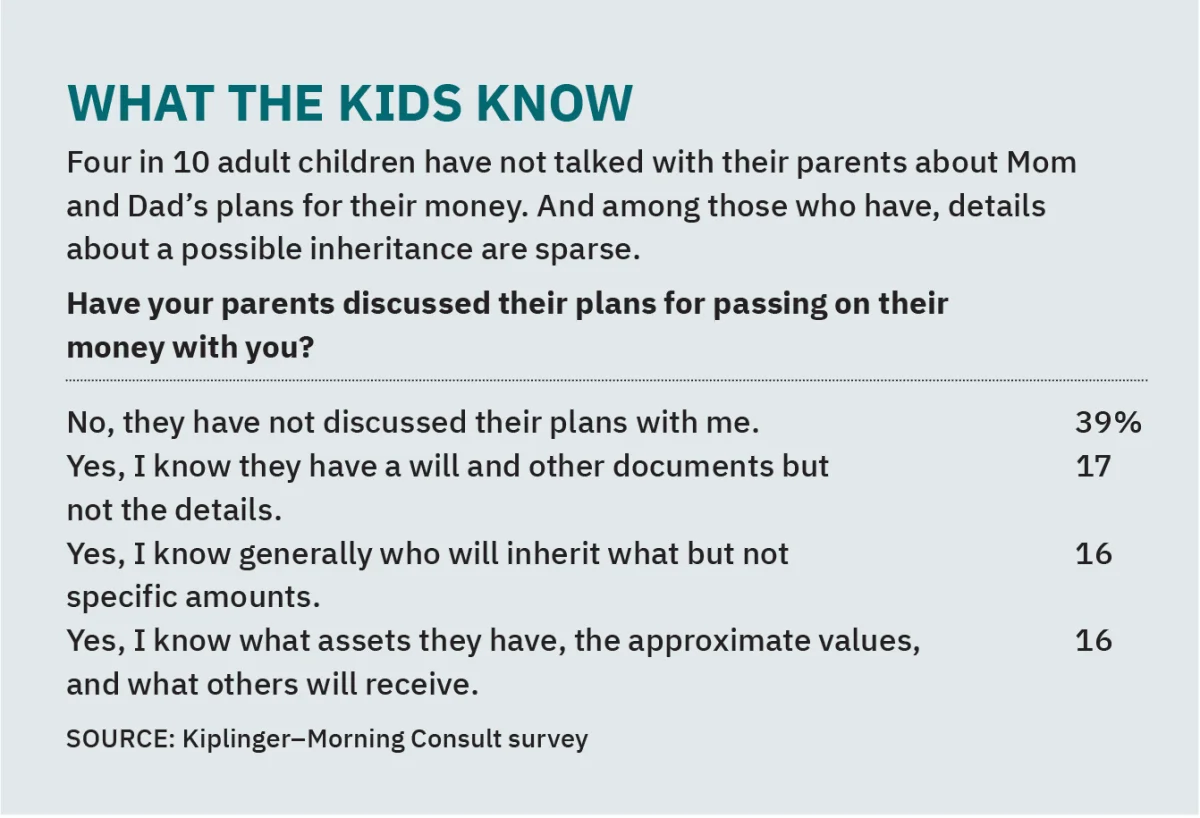
About 38% of parents and 39% of adult children said they had never discussed plans for the parents’ assets. The gap is wider among parents with smaller estimated estates: nearly half of those with less than $100,000 said they hadn’t discussed plans with their children. Among parents estimating their estate at more than $500,000, one-quarter said the same.
The amount involved doesn’t determine whether a family conversation is worthwhile. A modest estate can still include belongings with strong sentimental value, and disagreements may arise over who receives them. A general explanation of how a parent hopes to handle important items can give relatives a clearer starting point.
Families also vary in how much wealth they have to pass on. The survey’s accompanying discussion estimated that 2% of households account for more than half of the expected wealth transfer between generations. That unevenness makes assumptions especially risky: one family’s inheritance may look very different from another’s.
Uncertainty can keep people from starting

Among parents who had not discussed their plans, the most common reason was uncertainty about how long they would live or how much money would remain. Three in 10 parents worried that inflation and other financial pressures could reduce their estate. About one-quarter were concerned that health care and long-term care expenses might use up assets.
That uncertainty is real, but it doesn’t have to rule out a discussion. Parents can explain that plans may change as their circumstances do. They can share what they know now, describe what remains uncertain and revisit the subject later.
Uncertainty about the amount is common on both sides. Roughly two in five parents and two in five children said they didn’t know, or had no opinion, about how much might be inherited. Among people who named an amount, 17% to 18% expected less than $10,000. A larger inheritance was less commonly anticipated: 3% of younger adults and 5% of older adults named more than $1 million.
The reasons behind a plan matter, too
A precise estimate can help heirs prepare, but the figure alone may not answer their questions. Valerie Galinskaya, managing director and head of the Merrill Center for Family Wealth, said, “Inheritance is never only about money.” Adult children may also want to understand why a parent made particular decisions and how they chose to divide assets.
In the survey, 18% of younger adults said they would ask how much they would receive. Nearly as many, 16%, said they had no questions. Another 12% named emotional questions, such as whether their parents had enjoyed their lives. That spread suggests a useful conversation can cover more than account balances: it can explain family priorities, intentions and the values parents hope to pass along.
Make it a series of conversations

Planning a discussion can make it easier to approach. A Merrill Center for Family Wealth survey of wealthy families found that 78% of those who had recently talked about wealth did so spontaneously; 26% said they regretted those conversations. Parents don’t need a finished estate plan or a carefully scripted speech to begin. It may help to think about timing, the setting and whether adult children should hear the explanation together or separately.
Attorney Ryan Coon described estate planning as a process that develops over time. Family communication can follow the same pattern: start with what’s known, make room for questions and return to the plan as circumstances change. That approach can be more realistic than waiting for one ideal moment.
Put important wishes in writing
Sometimes a direct conversation isn’t possible or practical. A parent may be estranged from an heir, a beneficiary may need information presented differently, or a medical event may prevent a discussion. In those situations, estate planning documents and supporting materials can help communicate intentions.
A letter of intent can explain the thinking behind an estate plan. A trust may also set out how certain funds are to be used. Families considering these tools can consult an estate planning attorney and find professional directories through the National Association of Estate Planners and Councils or the American College of Trust and Estate Counsel.
Parents in the survey most often hoped an inheritance would improve their children’s lives and comfort. Younger adults most often wanted to support their own families or help others. Those shared intentions can make a useful starting point: explain what you hope the inheritance will do, then keep the conversation open as plans and needs evolve.