First day cover ·
Coat Closet Fixes That Keep Winter Gear Off the Floor
Winter gear piles up fast by the front door. These low-cost fixes, from hooks and rods to drying spots, can bring the entryway back under control.

By January, the coat closet by the front door has stopped being a closet. It's a heap of mittens, half-zipped snow pants, and one hook holding five people's coats through sheer stubbornness. I once opened ours to grab my own jacket and had three coats and a boot I'd been hunting since Christmas land on my head. For two winters I told myself the rod would sort itself out. It didn't, and one rod just doesn't work for a family of five.

The good news is that most of the fixes below cost nothing, or close to it. They're small changes, and you can start with whichever one annoys you most this week.
Start With Hooks, Not the Rod
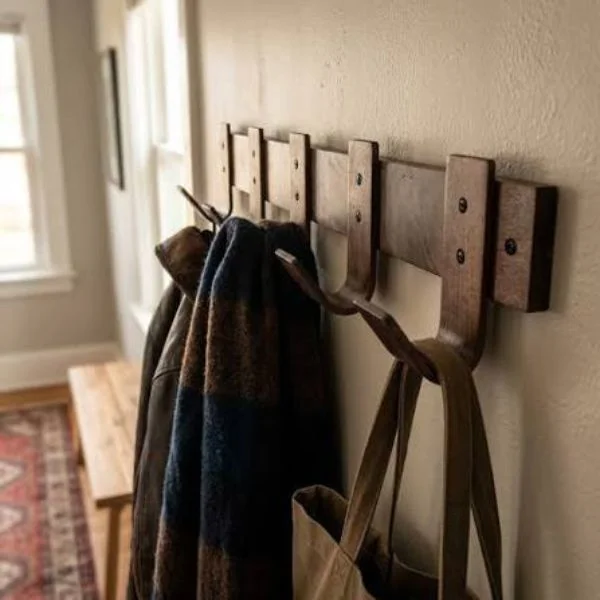
Give everyone a hook first. Count the people in the house and add one or two for guests. A family of four needs 4 to 6 hooks within arm's reach of the door. Before you buy anything, check for hooks already sitting unused on the back of a bedroom door or in the garage. Reusing them is free. If you're starting from scratch, a Command hook strip or a set of adhesive wall hooks runs about $5 to $15 at Target, and neither needs a drill.
A hook also beats a hanger for speed. Hanging a coat on a hook takes a second. A hanger takes five. On a busy weekday morning, those few seconds decide whether the coats end up on the bench or on their hooks.
Next, put some hooks at kid height. Adult hooks usually sit around 60 inches off the floor, which means a young child's coat ends up in a puddle underneath. Mount hooks at roughly 36 to 40 inches, or just above a child's shoulder. Moving hooks you already own costs an afternoon with a screwdriver. New adhesive hooks run $5 to $8 for a two-pack at Walmart.
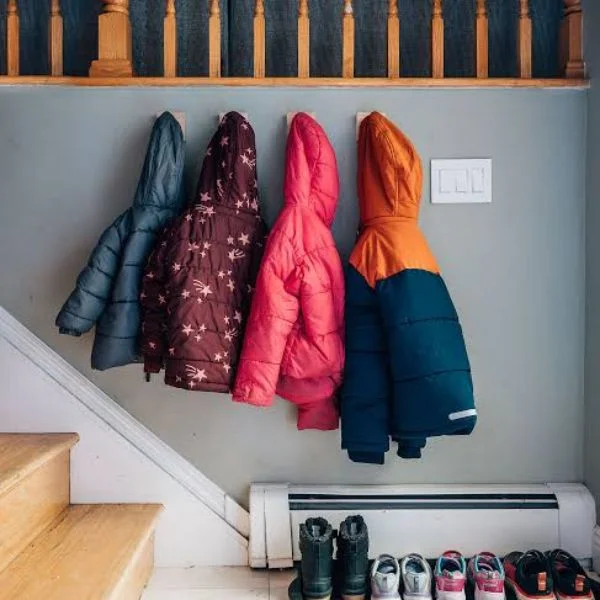
Give each kid a hook they can call their own and let them choose it. Kids tend to hang up a coat they picked themselves, and that small ownership does more than any reminder you could nag out of them.
Make the Rod Work Harder

Bulky plastic hangers eat up space. When my kids were small, our hall closet rod was packed with them, with maybe four inches between coats. Pulling out one jacket dragged three others along with it.
Slim velvet hangers help a lot. A pack of 10 to 20 costs about $10 to $15 at Target or Amazon. They're roughly half the thickness of standard plastic, so a rod that held eight coats will often take eleven or twelve. The flocked surface is the feature that matters most. Coats stay on the hanger instead of sliding off onto the floor.
Now save room for guests. Leave three or four empty hangers at one end of the rod and mark them as off limits for daily coats. It costs nothing and takes about two minutes. A strip of painter's tape or a ribbon tied where the guest section begins makes the boundary visible. Without that, those hangers fill up by February, and guest coats end up on your bed, where you'll be moving them again at midnight.

Dividing the rod is the next step. Hooks tend to get assigned naturally, but rods turn into a free-for-all. Give each person a named section so nobody has to dig for their own coat. Cut rectangles from a cereal box, punch a hole in the top, write a name on each, and loop them over the rod. It's a ten-minute job with no cost. Plastic rod dividers are another option, at about $10 for a multi-pack on Amazon. When every coat has a labeled place, putting it back takes no thought at all, and skipping the decisions is what keeps a system running past week two.
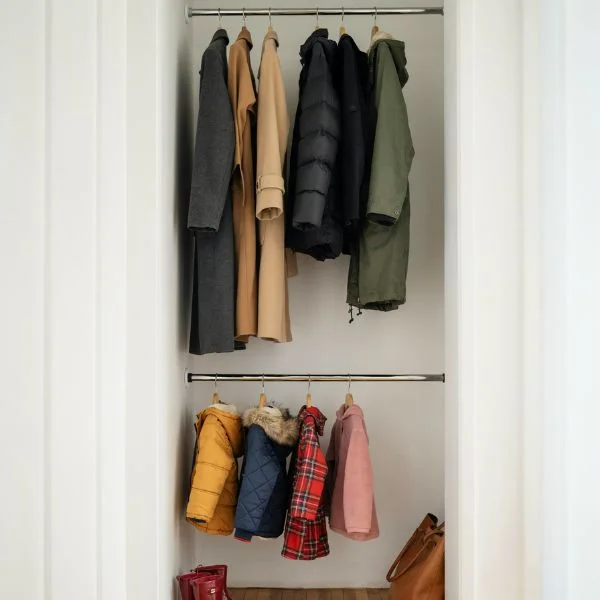
Here's another spot you may be wasting. Most hall closets have roughly two feet of empty air between the bottom of the coats and the floor. A spring tension rod wedged across that gap gives kids a rod at their own height. Tension rods cost $8 to $15 at Walmart or Target depending on width, and they install in under five minutes without hardware. Measure the inside width first, then choose a size whose range puts the opening close to the middle of the closet. A spare curtain rod works too.
Finally, keep one everyday coat per person in the front of the rod, nearest the door. Slide the rest toward the far end. Most of us own more coats than we wear, including the dress coat nobody has touched since a funeral and the jacket that's too thin for January but too warm for the car. Keeping the front section limited to daily wear means you can grab the right coat in seconds, even after a long afternoon when coats pile up quickly. This costs nothing and takes about fifteen minutes.
Tame the Hats, Mittens and Scarves
Small items cause most of the chaos, so they need their own homes. Start with the bins. A bin without a name becomes the family junk bin within a few days. Painter's tape or masking tape and a marker will label it, and most homes already have both. For kids who can't read yet, tape a photo of their hat to the bin, or assign a color, like a red bin for one child and a blue one for another. Dollar Tree sells dry-erase label stickers for $1.25 a pack. Those are handy because you can change the names as the kids grow. A label settles arguments without you having to referee.
Mittens are the real problem. One fix is a clear over-the-door shoe organizer used for gloves. It gives you around 24 pockets on a door you already walk past. Put one pair in each pocket, where you can see it through the plastic. These organizers cost roughly $12 to $20 at Target or Amazon, and the ones with reinforced hooks tend to hold up better than thin vinyl versions. If you'd rather keep gloves in a bin, clip each pair together before it goes in. A wooden clothespin or binder clip does the job, and a bag of wooden clothespins is $1.25 at Dollar Tree. Walmart also sells mitten clips that attach to a coat sleeve for roughly $5 to $8 a pair. One second of clipping now saves a frantic search when the snow is already falling.
Scarves are easy to tangle, but shower curtain rings help. Clip rings onto a single hanger, and a foot or so of rod space can hold ten or twelve scarves. Loop each scarf through a ring, and it hangs straight instead of sliding into a heap. Dollar Tree sells a set of plastic rings for $1.25, and Walmart's metal snap-style rings cost about $4 to $6 a set. If you have a spare set from a bathroom update, the cost is zero. Putting a scarf back takes the same motion as pulling one down.
Hats and gloves that get worn every day belong somewhere else. A shallow basket in the entryway, right where coats come off, holds the week's set. The closet bin is for storage, and the basket is for daily use. Any basket you already own works, so the price is zero. Shallow woven or wire baskets run about $10 to $15 at Walmart or Target. Pick a wide, low basket over a deep one, because nothing gets buried at the bottom.
Keep one more bin for overflow, like orphan gloves and stocking caps nobody claims. A tote or shoebox you already own costs nothing. A lidded shoebox-size tote from Walmart runs about $4 to $7 if you want something that stacks. Keep it on a closet shelf. It will come in handy the next time a friend shows up for sledding without a hat.
Give Wet Gear Its Own Route
Wet gear causes the biggest headaches, so it needs a clear path from the door to dry. Wet hats and gloves dry best with moving air, not heat. A folding drying rack in a corner with decent airflow can handle a whole family's gloves at once. If you already own one, it costs nothing. A basic folding rack runs about $15 to $25 at Walmart. Spread gloves with the fingers up, and leave a few inches between pairs so air can reach the inside.
Keep wet gear away from heat. Never set damp items on or against a space heater or a radiator. Direct heat can be a fire risk for damp shells, and it can also break down the water repellency of the fabric. Wet goes on the rack, and dry goes in the bin.
Hooks inside the entry door give wet coats somewhere to drip. Hang a snowy jacket next to five dry ones on the closet rod, and the whole closet soon smells damp. Two or three hooks on the inside of the door, or on the wall beside it, let coats dry before they go back into the closet. Command hooks cost about $8 to $12 for a multi-pack at Target, and an over-the-door hook rack runs around $12 to $20. If you already have hooks there, you don't need to buy anything. Coats go on the nearest hook when they come in, and they move into the closet once they're dry.
Drips will still reach the floor, so put a mat or a folded old bath towel under the wet-coat hooks. A towel you already own costs nothing, and a rubber-backed utility mat is about $10 to $20 at Walmart. This setup is for sleeve drips and coat hems only. Boots need their own spot. A towel can go in the wash, and a mat can be shaken out the front door. A few seconds of upkeep is far easier than mopping the same patch all winter.
Snow pants and bibs are their own category. They soak up water and are too bulky to share a hook. A spring tension rod across the bathtub or an unused stretch of the hall closet gives them a place to drip without soaking anything underneath. Tension rods cost about $8 to $15 at Walmart. Pants clips, which hold snow pants by the cuffs, run about $10 for a pack of ten at Target, or cost nothing if you already have a few. Hang bibs by the straps so water runs off the cuffs. Damp snow pants mean nobody heads back out the next day in soggy pants.
Some gear is too wet for any hook. A hat that's gone face-first into a snowbank, or gloves that spent twenty minutes packing snowballs, need a bin. Set a plastic laundry basket or an old dishpan by the door to catch them before they go into the dryer or onto the rack. A dishpan is $1.25 at Dollar Tree, and a laundry basket runs around $6 to $10 at Walmart. Anything already in the house costs nothing. Stick with plastic here. Fabric and wicker hold water along with the gear, and the basket turns musty by midwinter.
The smell is the last piece. A closet that holds wet coats all season will eventually smell like it. Mix equal parts white vinegar and water in a spray bottle and mist the closet walls and the inside of the gear bins about once a month. White vinegar runs about $4 a gallon at Walmart, and a spray bottle is $1.25 at Dollar Tree, so a full winter of this comes in under $6. Store-bought closet sprays cost around $6 to $9 a bottle, and they mostly cover the damp with a scent. After spraying, wipe with a dry cloth and leave the closet door open for an hour. Keep the bottle on the shelf so the job takes five minutes.
What to Fix First
A pile of mittens and snow gear doesn't mean you're behind. The closet was probably built for two coats and a vacuum, and five people walk through that door with wet gear at four in the afternoon. The fixes that matter most are the ones that solve whatever bothers you most. If mornings run long, start with hooks. If a puddle forms inside the door every afternoon, put a towel down tonight.
Good coat closet organization is a set of small decisions you only have to make once. Your closet won't look like a catalog photo, but by April you'll have forgotten what the mess used to look like.